Engineering Analysis for Prototypes and Design Optimization


Why Knowing How to Evaluate Prototypes Saves Time, Money, and Engineering Cycles
How to evaluate prototypes is one of the most important skills in product development. Here is a quick overview of the core steps:
- Define clear objectives — Know what you are testing before you build anything.
- Match fidelity to your stage — Use low-fidelity models early; use high-fidelity models closer to production.
- Choose the right evaluation method — Options include usability testing, functional testing, Design for Manufacturability (DFM) analysis, and A/B testing.
- Recruit the right participants — Test with people who reflect your real end users or operators.
- Capture and organize feedback — Use structured methods like affinity mapping or a Feedback Capture Grid.
- Prioritize issues and iterate — Rank problems by impact and fix them before moving to the next stage.
Building the wrong thing is expensive. An early-stage team can spend months refining a feature or component that fails the moment it reaches real users — or worse, the production floor. In the automotive supply chain, that kind of misdirection does not just waste engineering hours; it can delay an entire assembly line.
The core purpose of prototype evaluation is simple: find problems early, when they are cheapest to fix. Changes made at the prototype stage cost a fraction of what post-launch or post-production corrections require. According to research on product development best practices, 35% of startups fail simply because there is no real-world need for their product — a problem that structured prototype testing is designed to prevent.
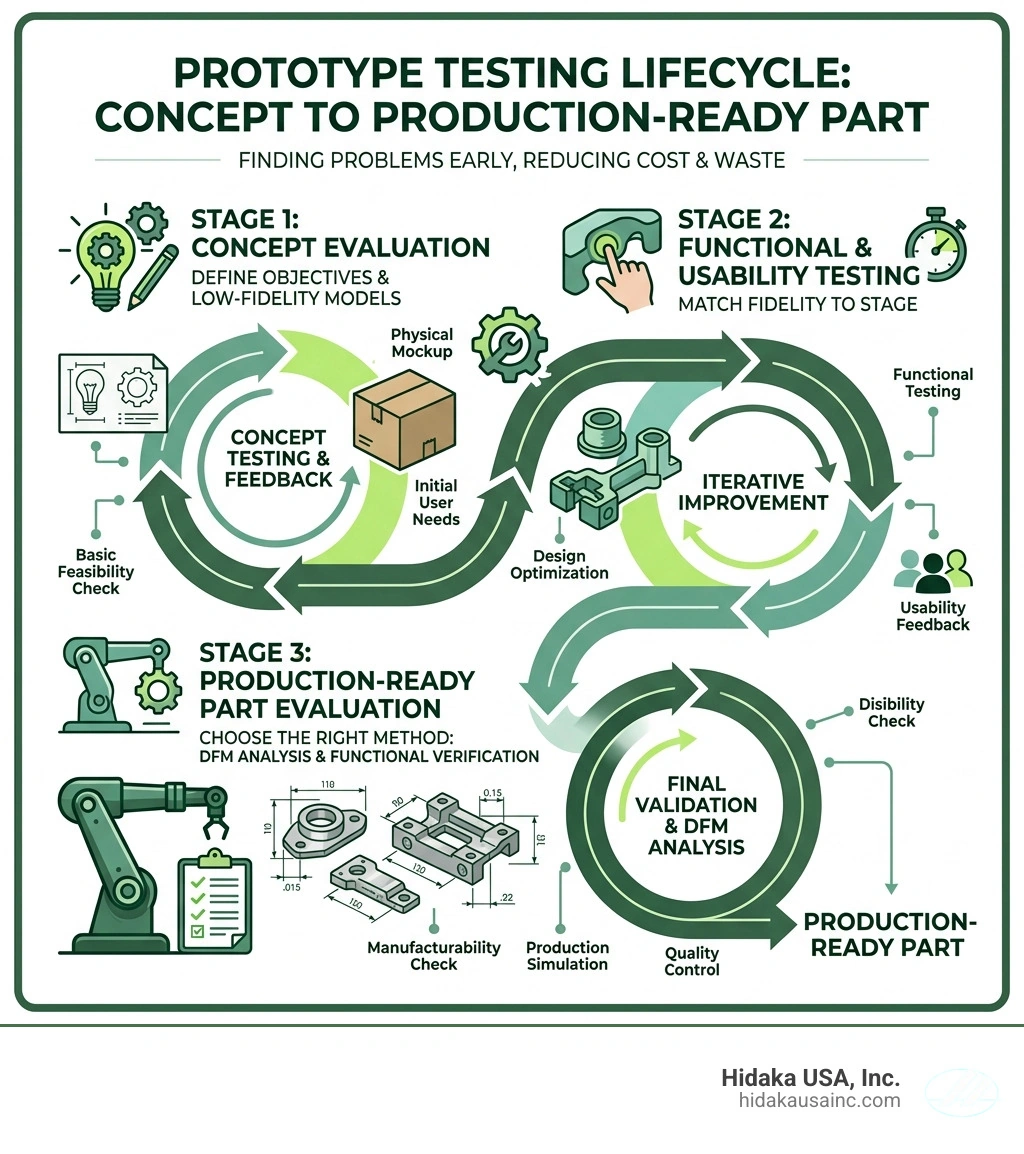
Prototype evaluation is not a single test. It is an iterative process that runs alongside development, from rough concept sketches all the way through functional, production-ready parts. Each stage asks a different question:
- Does this concept solve the right problem?
- Can users or operators interact with it as intended?
- Can it actually be manufactured to spec, on time, and at scale?
I'm Yoshihiro Hidaka, founder of Hidaka USA, Inc., with over 35 years of experience in sheet metal fabrication and prototype manufacturing for the automotive industry — experience that has shown me how rigorous, stage-appropriate prototype evaluation separates successful products from costly rework. In the sections below, I'll walk through the methods, tools, and frameworks that make how to evaluate prototypes a reliable, repeatable discipline rather than a guessing game.
How to evaluate prototypes vocabulary:
The Fundamentals of How to Evaluate Prototypes

When we look at how to evaluate prototypes, we aren't just looking for "likes" and "dislikes." We are conducting a strategic inquiry. In industries like automotive and mass-transit railcar manufacturing, a prototype is a tool for de-risking a roadmap. If we don't catch a clearance issue or a structural weakness now, we pay for it ten times over during mass production.
Effective evaluation starts with a shift in mindset: the prototype is an experimental instrument, not a final showpiece. Whether you are working with rapid metal prototyping or a simple cardboard mockup, the goal is to surface evidence-based data. As noted in The Modern PM's Guide to Testing Prototypes, a prototype test is a superpower that turns abstract concepts into tangible feedback.
Defining Clear Objectives and Hypotheses
Before we fire up a laser cutter or a 3D printer, we must ask: "What exactly are we trying to learn?" We recommend framing your goals as falsifiable hypotheses. For example, instead of saying "we want to see if the bracket works," try "we believe an operator can install this bracket in under 45 seconds using standard tools."
By setting these specific success metrics early, we ensure stakeholder alignment. It prevents the "Goldilocks Problem"—where a prototype is either too simple to give real data or too polished to allow for honest criticism. Clear objectives keep the team focused on the "must-knows" rather than the "nice-to-haves."
The Economics of Early Validation
The "Rule of Ten" is a common concept in engineering: every stage you move forward without fixing a flaw increases the cost of that fix by a factor of ten. Finding a flaw in a digital wireframe costs a few hours of design time. Finding it in a rapid metal prototyping stage costs a few hundred dollars. Finding it after the tooling for mass production has been cut can cost hundreds of thousands of dollars and months of delays.
In our Dublin, Ohio facility, we emphasize that early validation is essentially "cheap insurance." By investing in rigorous evaluation now, you protect your engineering cycles and ensure that when you finally commit to mass production, you are building a product that is already proven to work.
Selecting Evaluation Methods Based on Prototype Fidelity
Not every prototype needs to be a functional metal part. How to evaluate prototypes effectively involves matching the "fidelity"—or level of detail—to the specific question you need answered.
| Prototype Fidelity | Best For | Typical Methods |
|---|---|---|
| Low-Fidelity | Concept validation, basic layout, logic | Paper sketches, cardboard mockups, wireframes |
| Mid-Fidelity | User flow, ergonomics, spatial relations | 3D prints, foam models, basic prototype sheet metal fabrication |
| High-Fidelity | Functional testing, DFM, final validation | CNC machining, 3D laser cutting, production-grade materials |
Low-Fidelity and Conceptual Testing
In the earliest stages, we want to fail fast and cheap. Low-fidelity prototypes, such as paper sketches or simple wireframes, are surprisingly effective. According to the guide Test Your Prototypes: How to Gather Feedback and Maximise Learning, users are often more comfortable giving honest, critical feedback on rough drafts because they don't feel the design is "finished" yet.
This stage is about concept viability. Does the user understand the basic logic? Does the physical layout make sense? If you are designing a new dashboard interface for a railcar, a simple paper mockup can reveal if a button is placed in an unreachable spot before a single line of code is written or a single piece of metal is cut.
High-Fidelity and Functional Evaluation
Once the concept is stable, we move to high-fidelity versions. This is where we use how to prototype metal parts techniques to create pieces that look and act like the final product. High-fidelity prototypes allow us to test "fit and function."
We might use 3D printing for complex geometries or CNC machining for parts that require engineering-grade strength. In our automotive work, this stage is critical for verifying that a part can withstand the thermal and mechanical stresses it will face in the real world.
How to evaluate prototypes for usability

Usability isn't just for software; it's vital for physical hardware too. This is often referred to as Human-Factors Engineering (HFE). We want to observe how a person actually uses the product.
- Moderated Testing: We watch the user in real-time. We use a "think-aloud protocol," asking them to narrate their thoughts as they interact with the prototype.
- Unmoderated Studies: Users interact with the prototype on their own, often recorded via video, providing insights into how they behave without a guide present.
- The Silence Rule: As noted in Prototyping | A.M. Toolbox, the moderator's most powerful tool is silence. By counting to ten when a user pauses, we allow them to solve the problem themselves, which reveals their true mental model.
Step-by-Step Process for Engineering-Led Prototype Testing
Once you have your prototype, it's time to run the test. This process should be systematic to ensure the data you collect is reliable and actionable.
Planning and Scripting the Test
A good test needs a script, but not a rigid one. We create task-based scenarios—for example, "Imagine you are a technician performing a 10,000-mile service; use this tool to access the oil filter." This gives the participant context.
We also determine our sample size. A famous rule in UX research states that testing with just five participants can uncover roughly 85% of usability issues. While complex automotive systems might require more, starting with five is a great way to find the most glaring problems quickly.
Executing the Evaluation
During the test, we act as neutral observers. We avoid "selling" the idea or explaining how it's supposed to work. We look for nonverbal cues—frustration, hesitation, or a "lightbulb moment."
If we are testing a part created through prototype machining, we pay close attention to how the user handles the physical weight and texture. Does the part feel durable? Is it intuitive to grip? These qualitative insights are just as important as the quantitative data.
How to evaluate prototypes for manufacturability
This is where engineering analysis takes center stage. We don't just want to know if it works; we want to know if we can build it efficiently. This is called Design for Manufacturability (DFM).
At Hidaka USA, Inc., we use our ISO 9001 and AWS certifications as benchmarks for quality. When we evaluate a precision sheet metal prototyping project, we look for:
- Tolerances: Are the requirements realistic for mass production?
- Material Choice: Can we achieve the same strength with a more cost-effective or easier-to-source metal?
- Process Optimization: Could a 2D laser cut followed by a hydraulic press be faster than complex machining?
By answering these questions during the 3D laser prototype services phase, we ensure a smooth transition to mass production.
Analyzing Results and Prioritizing Design Iterations
After the tests are complete, you will likely have a mountain of notes, videos, and data points. The challenge is turning that "noise" into a "signal."
Organizing Feedback Frameworks
We use several frameworks to keep feedback organized and objective:
- Feedback Capture Grid: A simple four-quadrant map divided into "Likes," "Criticisms," "Questions," and "Ideas."
- I Like, I Wish, What If: This encourages participants (and internal teams) to provide constructive criticism. "I like the weight of the part, I wish the handle was wider, what if we used a textured coating?"
- Affinity Mapping: We group similar pieces of feedback together to see which issues are recurring. If four out of five testers struggled with the same bolt placement, that's a high-priority signal.
According to the Prototype Testing: Step-by-Step Guide to Validating Designs | Maze, these structured methods prevent "social desirability bias," where testers are too polite to tell you your design has flaws.
Prioritization and Implementation
Not every piece of feedback requires a change. We use an Impact vs. Effort matrix to decide what to fix first.
- High Impact / Low Effort: These are "quick wins" that should be addressed immediately.
- High Impact / High Effort: These are major design iterations that might require a new prototype.
- Low Impact / Low Effort: These are minor polishes to be handled if time permits.
- Low Impact / High Effort: These are usually ignored or deferred.
We also classify issues by severity. A "blocker" (something that prevents the product from working safely or correctly) always takes precedence over a "cosmetic" issue.
Frequently Asked Questions about Prototype Evaluation
How many participants are needed for a valid prototype test?
For qualitative testing—where you want to find out why something isn't working—the "five-user rule" is the industry standard. Testing with five people typically uncovers about 85% of usability and design issues. If you are doing quantitative testing (like A/B testing two different designs for statistical significance), you may need 30 or more participants.
What is the best time to test a prototype during development?
The best time is "early and often." Specifically, you should test:
- At the conceptual stage to validate the core idea.
- At major design milestones to ensure the project is still on track.
- Before committing to production tooling to catch expensive mechanical or DFM issues.
- Post-launch to gather data for the next version.
What are the most common pitfalls in prototype testing?
- Social Desirability Bias: Participants being too nice. Avoid this by asking "What is the one thing you would change?"
- Leading Questions: Asking "Don't you think this handle is comfortable?" instead of "How does the handle feel?"
- The Wrong Audience: Testing a specialized automotive part with people who don't work in the industry.
- Over-Polishing: Making an early prototype look so perfect that testers are afraid to suggest changes.
Conclusion
Mastering how to evaluate prototypes is the difference between a product that thrives and one that stalls. Whether we are working on high-performance components for the motorsports industry or safety-critical parts for mass-transit railcars, our approach at Hidaka USA, Inc. remains the same: validate early, test rigorously, and iterate based on data.
By combining advanced engineering analysis with real-world usability testing, we help our partners move from concept to mass production with confidence. In our 95,000-square-foot facility in Dublin, Ohio, we maintain the strict quality control standards—including ISO 9001 and AWS certifications—that the automotive and rail industries demand.
If you are ready to take your project from a rough idea to a production-ready reality, we are here to help. Our team specializes in everything from rapid metal prototyping to full-scale assembly, ensuring your designs are not just functional, but optimized for the American manufacturing landscape.
For more information on how we can support your next project with professional prototyping and engineering services, visit us at Hidaka USA, Inc.. Let's build something that works—the first time.