Ohio Valley Manufacturing and the Future of Heavy Gauge Stamping


Why High Volume Stamping Ohio Is the Backbone of Midwest Manufacturing
High volume stamping Ohio is a well-established manufacturing sector that serves industries ranging from automotive and heavy truck to agriculture and military equipment. Ohio is home to dozens of stamping facilities operating presses from 30 tons up to 4,000 tons, capable of handling material thicknesses from 0.020" to 0.625" across carbon steel, aluminum, stainless steel, and more.
Here is a quick overview of what Ohio high volume stamping offers:
| Factor | Details |
|---|---|
| Press capacity range | 30 tons to 4,000 tons |
| Material thickness | 0.020" to 0.625" |
| Common materials | Carbon steel, aluminum, stainless steel |
| Key industries served | Automotive, military, agriculture, heavy truck, appliance |
| Standard certifications | ISO 9001:2015, AS9100, TS compliant |
| Typical value-added services | Welding, assembly, powder coating, heat treating, deburring |
| Production speed | 12–25 cycles per minute on heavy gauge lines |
Ohio's central location, skilled workforce, and deep industrial heritage make it one of the strongest regions in the US for high volume metal stamping. Manufacturers across the Midwest rely on Ohio-based stampers for consistent, repeatable parts at scale.
I'm Yoshihiro Hidaka, founder of Hidaka USA, Inc. in Dublin, Ohio, where I have spent over three decades growing a sheet metal fabrication company from prototype supply into full-scale high volume stamping Ohio production across multiple industries. That experience informs every section of this guide, which will walk you through the key capabilities, companies, and considerations you need to find the right stamping partner.
High volume stamping Ohio terms simplified:
Defining High Volume Stamping Ohio
When we talk about High volume stamping Ohio, we are describing the industrial process of transforming flat metal sheets or coils into specific shapes using massive presses and specialized dies. But what exactly qualifies as "high volume" in 2026? Generally, this refers to production runs where the quantity of parts justifies the significant upfront investment in permanent tooling—often ranging from tens of thousands to millions of units annually.
Unlike low volume stamping or prototyping, which might use soft tooling or laser cutting to produce a few hundred parts, high volume production relies on speed and automation. In the Ohio manufacturing corridor, high-volume lines often run at speeds of 12 to 25 cycles per minute for heavy parts, and much faster for precision electronics or automotive clips. This creates a massive cost-per-part efficiency that simply cannot be matched by other manufacturing methods.
For those just starting a project, it is often wise to look into prototyping services first. At Hidaka USA, Inc., we often help clients bridge the gap between a design concept and a mass-production-ready part, ensuring the geometry is optimized before the expensive high-volume dies are cut.
The Mechanics of High Volume Stamping Ohio
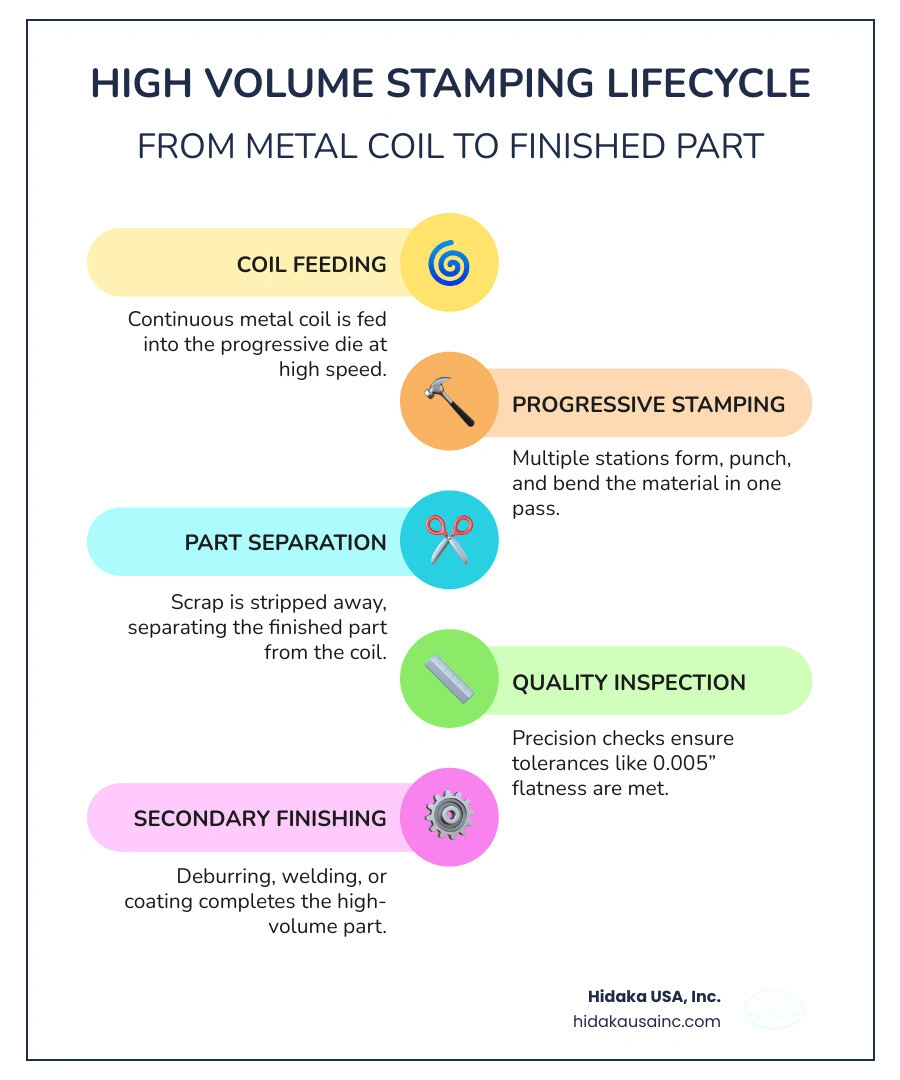
The "magic" happens through progressive dies. Imagine a long strip of metal being fed from a massive coil into a press. With every "thunk" of the machine, the metal moves forward, and a different stage of the part is formed. By the time the strip reaches the end of the press, a finished part pops out.
This process offers incredible repeatability. Once the die is dialed in, the millionth part looks exactly like the first. However, this requires meticulous tool maintenance. Because these machines run so fast and with such force, the dies must be regularly inspected and sharpened to prevent burrs or dimensional drift. In Ohio, top-tier shops handle all engineering changes and die maintenance in-house to keep the lines moving without delay.
Scalability and Production Speed
In 2026, manufacturing trends are leaning heavily toward "just-in-time" delivery and tighter supply chain integration. High volume stamping allows us to meet these demands by maximizing throughput. With modern coil feeding systems and automated scrap removal, a single press can produce more parts in a day than a manual shop could produce in a month.
This scalability is vital for industries like automotive, where a delay in a single stamped bracket can halt an entire assembly line. By integrating sophisticated ERP (Enterprise Resource Planning) systems, Ohio stampers can provide real-time visibility into production schedules, helping customers manage their inventory more effectively.
Technical Capabilities: Tonnage, Materials, and Heavy Gauge Precision
The "muscle" behind Ohio's stamping industry is found in its press capacity. The state hosts an incredible range of machinery, from 30-ton presses for tiny, intricate components to 4,000-ton monsters that can shape thick plate steel for truck frames.
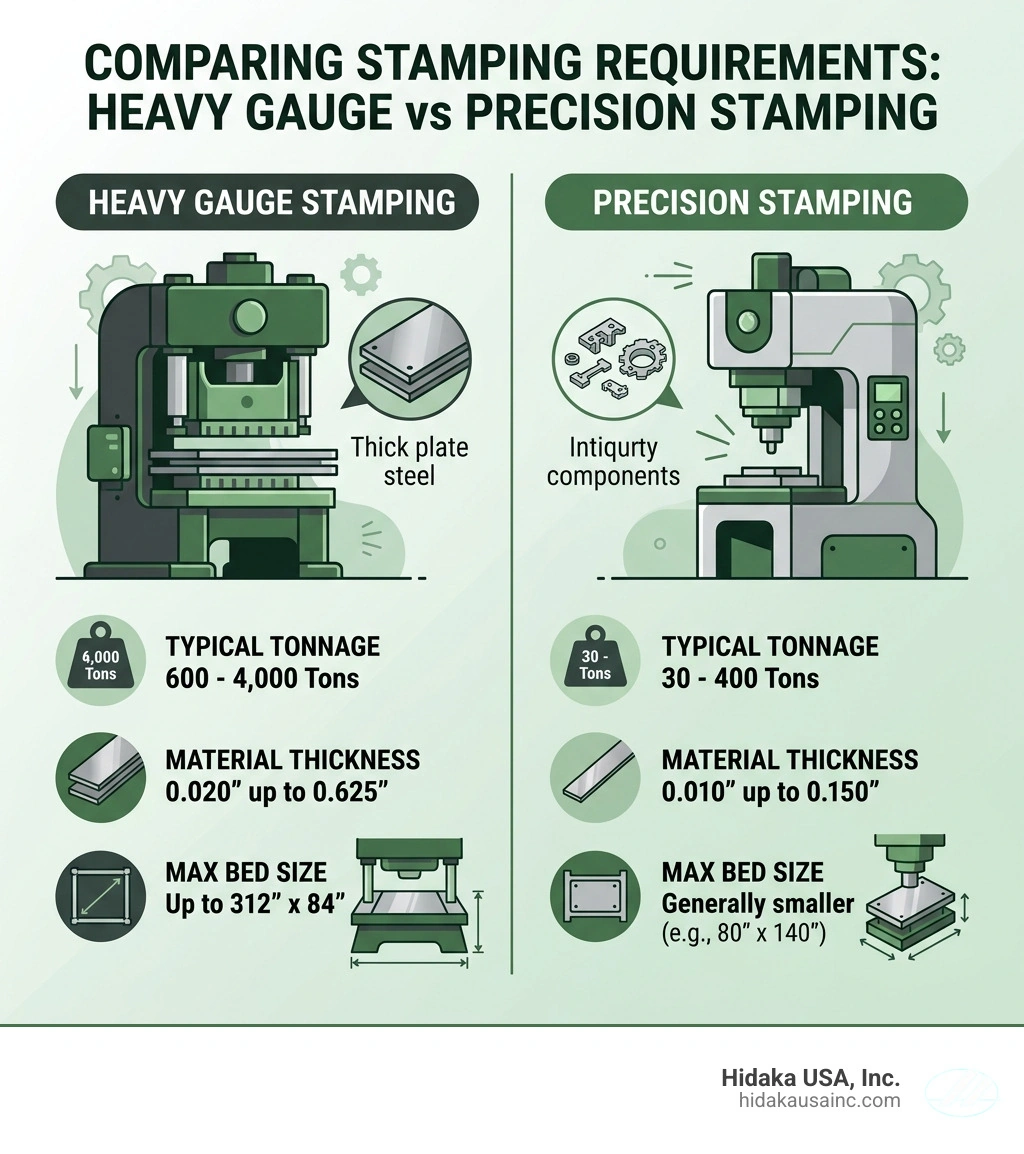
| Specification | Heavy Gauge Stamping | Precision Stamping |
|---|---|---|
| Typical Tonnage | 600 to 4,000 Tons | 30 to 400 Tons |
| Material Thickness | 0.020" up to 0.625" | 0.010" up to 0.150" |
| Max Bed Size | Up to 312" x 84" | Generally smaller (e.g., 80" x 140") |
| Primary Goal | Structural Integrity | Tight Tolerances / Complexity |
| Common Parts | Side rails, crossmembers, brackets | Terminals, connectors, small clips |
Materials Used in High Volume Stamping Ohio
While carbon steel remains the workhorse of the industry due to its strength and cost-effectiveness, the demand for lighter, more corrosion-resistant materials has skyrocketed. We see a significant amount of work going to Aluminum Stamping Companies Dublin Oh, USA, particularly for automotive components where weight reduction is a priority for electric vehicle range.
Other common materials include:
- Stainless Steel: Used for exhaust components, medical devices, and food-grade applications.
- Copper and Brass: Essential for electrical terminals and connectors due to high conductivity.
- High-Strength Low-Alloy (HSLA) Steel: Provides superior strength-to-weight ratios for safety-critical automotive parts.
- Exotic Alloys: Used in aerospace and specialized military applications.
Heavy Gauge vs. Precision Stamping
There is a distinct difference between "heavy gauge" and "precision" work. Heavy gauge stamping generally involves materials thicker than 25-gauge (0.020"). Working with these thicker metals requires massive tonnage and specialized leveling equipment. For example, some Ohio facilities use Hammerle leveling machines to achieve flatness within 0.005", which is critical when the stamped part must be robotically welded later.
Precision stamping, on the other hand, might use thinner materials but requires much tighter tolerances. This often involves CNC forming and high-speed mechanical presses that can run at hundreds of strokes per minute. Whether you need a 0.5" thick steel plate or a 0.010" thick copper contact, Ohio's infrastructure is built to handle it.
Why Ohio is the Epicenter of Mass Production Stamping
Ohio isn't just a place where things are made; it's a place where the entire ecosystem of manufacturing lives. From the proximity to North American steel mills to the density of the automotive supply chain, the state is perfectly positioned for high volume stamping Ohio.

The "Golden Triangle" of manufacturing—linking Ohio, Michigan, and Indiana—ensures that stamped parts don't have to travel far to reach their final assembly point. This reduces logistics costs and minimizes the risk of transit damage. Furthermore, Ohio Progressive Stamping Companies benefit from a workforce that has "manufacturing in its DNA," with generations of tool and die makers passing down their expertise.
Key Industries Served
While automotive is the largest consumer of stamped parts in the region, the diversity of Ohio's industrial base is impressive. At Hidaka USA, Inc., we've seen how the requirements of one industry can drive innovation in another.
- Motorsports: High-performance parts requiring extreme precision and specialized alloys.
- Mass-Transit Railcar: Large, structural stampings and assemblies that must meet rigorous safety standards.
- Military and Government: Parts for tactical vehicles and equipment where material traceability is non-negotiable.
- Renewable Energy: High-volume production of solar panel mounting brackets and hardware.
- Data Centers: Specialized enclosures and cooling system components.
Regional Advantages and Infrastructure
The Dublin and Columbus business hubs have become major centers for manufacturing technology. Being located in Dublin, Ohio, allows us to tap into a specialized corridor of engineering talent and logistics providers. In the economic climate of 2026, having a local partner who understands domestic regulations and can provide rapid turnaround is a massive competitive advantage over overseas sourcing. Ohio's industrial heritage combined with modern investment makes it a true powerhouse for mass production.
Value-Added Services and Quality Assurance in High Volume Runs
In today's market, customers rarely want just a "stamped part." They want a finished component or assembly. That is why the best Ohio stampers offer extensive value-added services. By performing secondary operations in-house, we can reduce the total lead time and eliminate the "finger-pointing" that happens when multiple vendors are involved.
Common value-added services include:
- Welding: Robotic MIG, TIG, and resistance (spot) welding for consistent, high-strength joints.
- Assembly: Riveting, staking, and light mechanical assembly of multiple stamped components.
- Finishing: Powder coating, plating, and heat treating to improve durability and appearance.
- Deburring: Vibratory finishing or power washing to ensure parts are safe to handle and free of sharp edges.
For more details on how these processes integrate into a large-scale project, you can explore more info about mass production.
Ensuring Precision and Quality Control
Quality is the bedrock of high-volume production. When you are making 100,000 parts, a tiny error in the die can result in 100,000 pieces of scrap. To prevent this, top-tier Ohio companies implement rigorous quality management systems.
- ISO 9001:2015: The international standard for quality management.
- CMM Inspection: Coordinate Measuring Machines that verify part dimensions against CAD models with micron-level accuracy.
- Micro-Vu Measuring: High-speed optical measuring systems for small, complex features.
- Material Traceability: Ensuring every coil of metal can be traced back to its original mill heat number.
- ERP/MRP Integration: Using software like Praxis to provide "cradle-to-grave" visibility of every part in the facility.
Selecting the Right Stamping Partner
Choosing a partner for high volume stamping Ohio is a long-term commitment. You aren't just buying a part; you are buying their engineering expertise and their ability to manage risk. Look for a partner that offers "Design for Manufacturability" (DFM) support. This means their engineers will look at your part design and suggest small changes that can significantly reduce tooling costs or improve production speed without sacrificing function.
In-house tooling is another "must-have." If a die breaks at 2:00 AM on a Tuesday, you want a partner who can fix it in their own tool room immediately, rather than waiting weeks for an outside shop to fit them into the schedule.
Frequently Asked Questions about High Volume Stamping Ohio
What are typical lead times and minimum order quantities?
In 2026, lead times for new tooling typically range from 8 to 16 weeks, depending on the complexity of the progressive die. Once the tooling is qualified and in-house, production lead times are much shorter—often 2 to 4 weeks for material procurement and scheduling. Regarding minimum order quantities (MOQs), most high-volume stampers look for annual volumes of at least 10,000 to 25,000 pieces to justify the setup time on large presses, though this varies by part size and complexity.
What certifications should a top-tier Ohio stamper hold?
At a minimum, any reputable stamper should be ISO 9001:2015 certified. For automotive work, IATF 16949 (formerly TS 16949) is the gold standard. If you are in the aerospace or defense sector, look for AS9100 and ITAR registration. For projects involving critical structural joints, AWS (American Welding Society) certification for their welding staff is essential.
How has technology advanced high volume stamping?
Technology has moved far beyond simple mechanical presses. Today, we use advanced simulation software (like AutoForm or PAM-STAMP) to predict how metal will flow and thin during the stamping process before we ever cut a piece of steel for the die. This saves thousands of dollars in trial-and-error. On the factory floor, 6-axis back gauges on press brakes and robotic transfer systems have made the process safer and more precise. Real-time monitoring sensors on the presses can now detect a "slug pull" or a misfeed and stop the machine instantly, preventing damage to the expensive progressive dies.
Conclusion
The future of high volume stamping Ohio is bright, driven by a perfect blend of "Old School" craftsmanship and "New School" technology. Whether you are looking for heavy gauge structural parts or high-precision automotive components, the infrastructure in the Ohio Valley is unmatched.
At Hidaka USA, Inc., we pride ourselves on being a one-stop shop for our clients. From our 95,000 square foot facility in Dublin, Ohio, we provide the end-to-end support—from design and prototyping to full-scale mass production—that modern industry demands. By focusing on American-made quality and strict ISO-certified standards, we ensure that every "thunk" of our presses brings our customers closer to their goals. If you're ready to scale your production, the expertise you need is right here in the heart of Ohio.